


Across our health and social systems, we continue to carry bold but necessary ambitions. We speak about the potential for improving population health, enabling equitable access, and strengthening collective well-being. However, between what we intend to achieve and what we in reality experience, there is a familiar gap. It is the barrier where policy does not yet translate into practice, where innovation is overpowered by traditional practices, and where people who want to create and implement change feel held back by structures designed for a different era.
This series steps directly into that gap and aims to offer a provocation. A call to think, act, and lead differently together. It invites us to re-pattern how we approach change and to recognize that transformation does not begin with strategy. It begins with mindset and behaviour. It begins with how we collectively show up.
Over the past decade, through work across systems, sectors, jurisdictions, and communities, a consistent truth has surfaced. Our mindset and behaviour are the operating system of the future we create. They are the counterforce to the status quo. They are the accelerators that allow new ways of working to take root across communities, provinces, territories, and entire countries.
Through global research, lived practice, Indigenous teachings, and the lessons of leaders who have advanced large-scale change, fourteen mindset and behaviour shifts have emerged. These shifts are rooted in relational values and community-driven principles that set a framework for a new way of leading together. These shifts are observable and teachable. When embodied, they can enable the large-scale change that transactional approaches have repeatedly failed to realize.
To make these shifts actionable, the fourteen shifts are grouped across four thematic clusters:
Each cluster builds upon the last by re-anchoring the entire picture and deepening our commitments to relational, adaptive, and community-driven leadership.

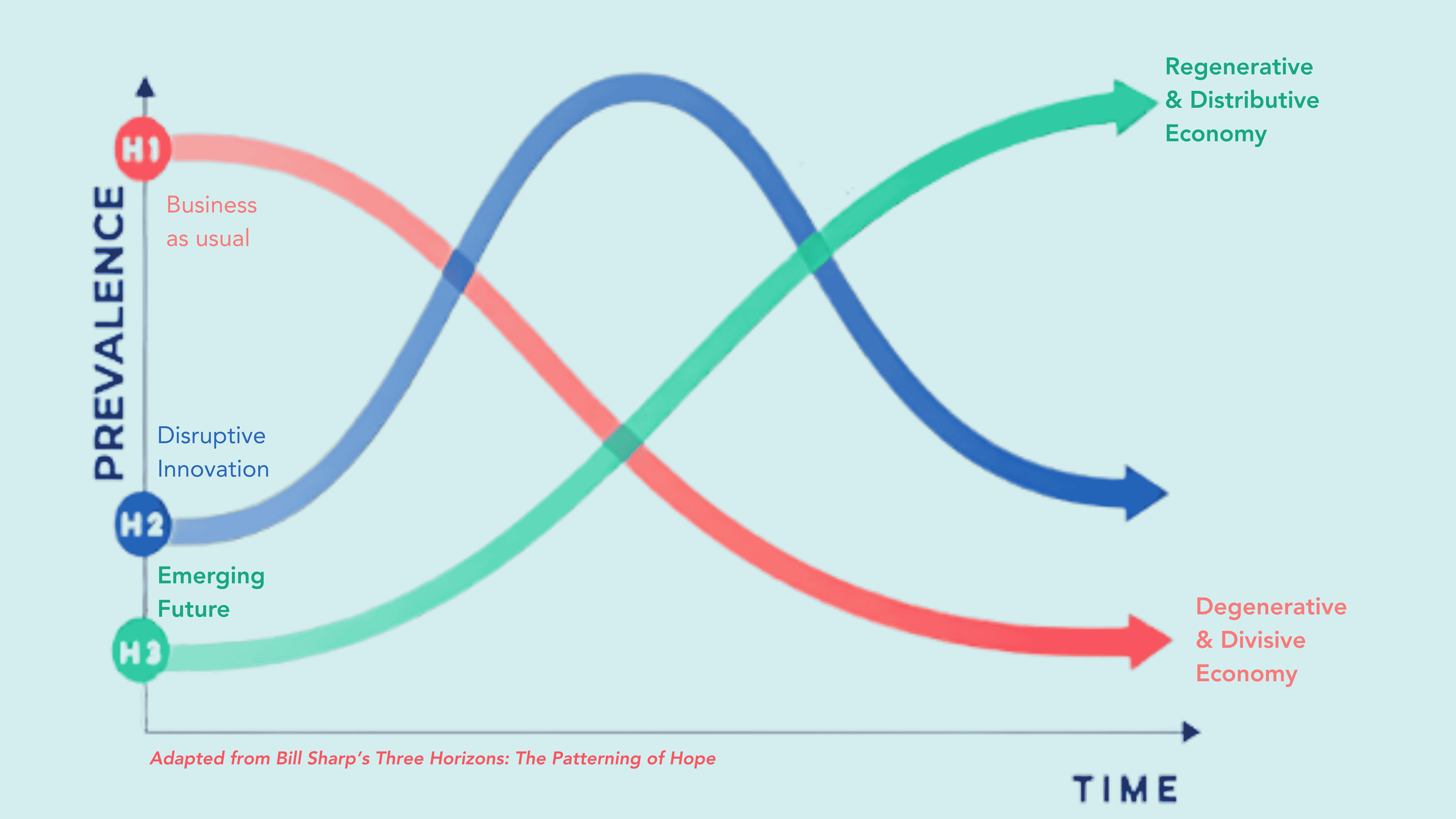
Using Bill Sharpe’s Three Horizons model, we see that Horizon 1 represents the status quo. It is where hierarchy dominates, competition fragments efforts, and organizations operate as individual entities rather than ecosystems. Horizon 3 represents the future we aspire to achieve where well-being, equity, and connection define how systems operate.
Horizon 2 is the target for change.
It is the in-between space where old patterns are challenged, where we learn and unlearn, where we begin experimenting with new power, co-creation, and shared purpose. It is a space shaped more by mindset and behaviour than by structure or strategy.
The fourteen shifts are the bridge between the world we currently have and the world we want in the future.
We are currently facing the highest levels of complexity our systems have ever known. The required shift is relational, interconnected, holistic, and grounded in community wisdom. Policy alone will not get us there. Structural integration will not get us there. New departments, new task forces, or new reporting frameworks will not get us there.
But mindset and behaviour can.
Mindset and behaviour unlock trust, enable shared accountability and open the door to co-creation. They create the conditions for flourishing. They are the seeds of Horizon 3. The possible future that we can pattern together.
This series is an invitation to shift not just conceptually, but behaviourally. Each blog will explore the fourteen shifts more deeply, showing how they reshape leadership, transform relationships, and create aligned, abundant, community-rooted systems.
Transformation does not begin with policy. It begins with people. It begins with how we choose to lead.