

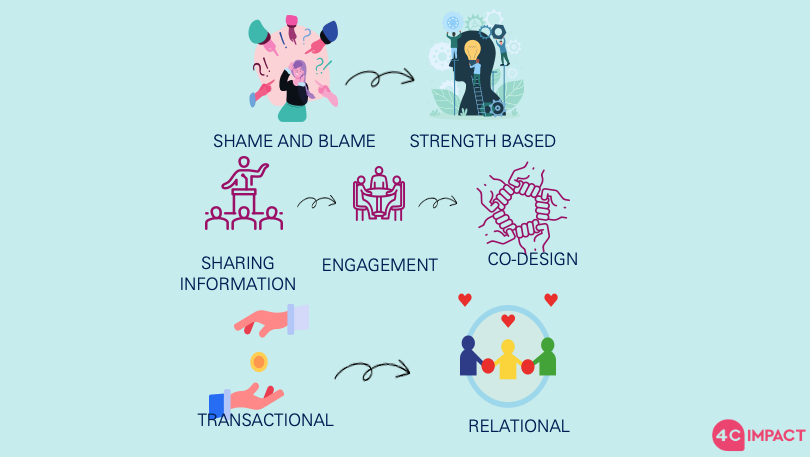
The second cluster of shifts focuses on connection. How we relate, communicate, and build trust across organizations and communities. These shifts are the heart of our collective philosophy and the core of relational system transformation.
For a long time, health and social care systems have relied on blame as a default explanation for failures. Hospitals blame primary care. Primary care blames home care. Home care blames funding structures. Everyone blames the system.
Yet blame rarely accounts for the complexity of the work, nor does it reflect an understanding of the constraints faced by each sector.
The shift to strength-based leadership begins with curiosity. It asks us to walk a step in each other’s environments. It invites us to see what is working, not only what is failing. Strength-based thinking opens the door to partnership because it acknowledges that every sector has expertise, insight, and value to contribute.
These three behaviours form a continuum.
Co-design is collaboration rooted in reciprocity and humility. It recognizes that those who live the experience understand the system differently and often more deeply than those who operate within it. This shift is backed by research demonstrating that systems improve when people are not simply consulted but empowered.
Transactional approaches focus on efficiency, structure, and outputs. But transactional systems have consistently failed to create integrated care or improved population well-being. They overlook the relational fabric that holds systems together.
Relational leadership acknowledges the simple truth that change happens at the speed of trust.
This shift invites leaders to pause, breathe, and reconnect with the human experience at the center of their work. As Dr. Gaynor Weston-Creed reminds us, relational leadership is a systemic competency that enables collective action.
This cluster of shifts equips leaders to move beyond surface-level coordination and into authentic collaboration. They move us from telling to listening, from reacting to understanding, and from isolated decisions to shared solutions.
These are the shifts that make systems feel human. They are also the shifts that create the conditions for large-scale change.